RetailOS: Offline-First Native Android POS & Local Inventory Platform
Architecting a fault-tolerant, zero-float retail engine with Room SQLite, transactional outbox synchronization, continuous CameraX ML Kit scanning, and Bluetooth ESC/POS thermal printing.
 RetailOS•Local-First & Distributed
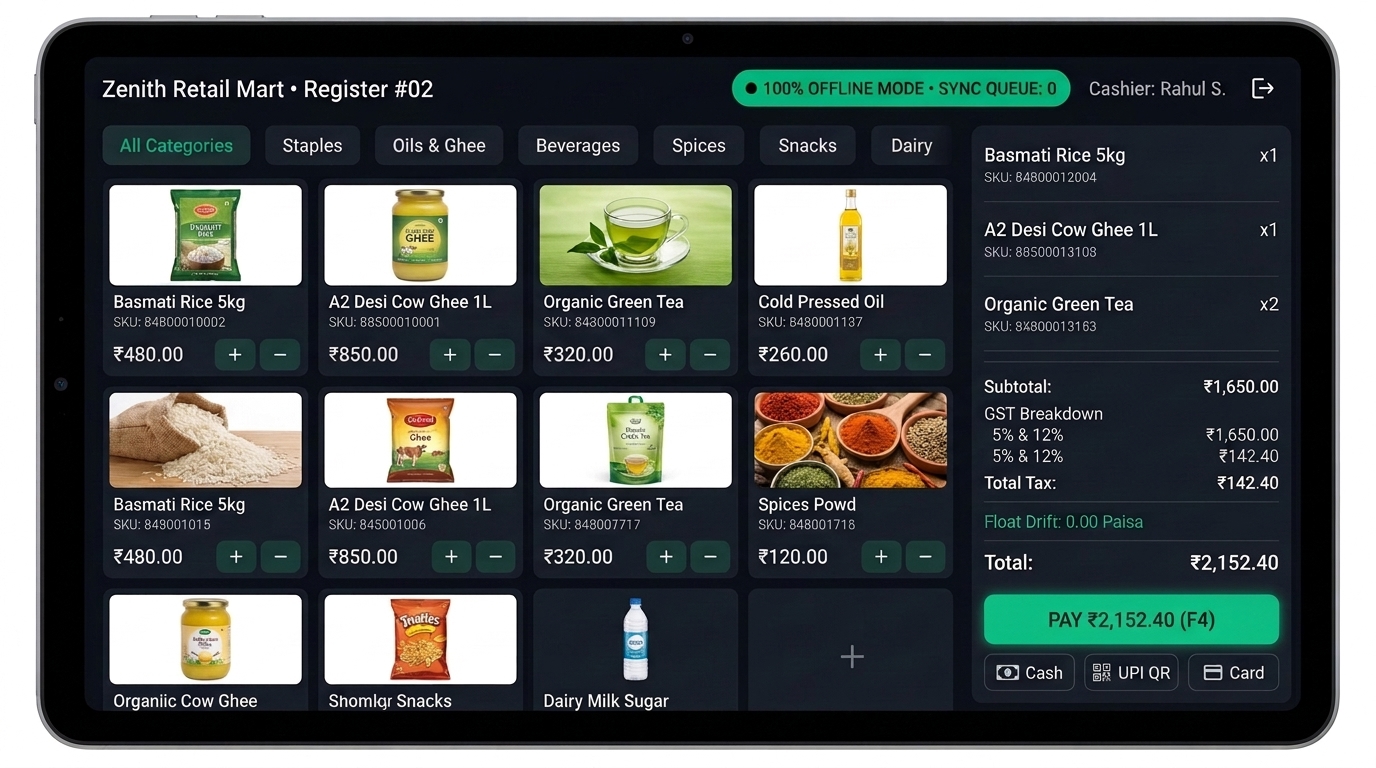
Executive Architecture Summary
RetailOS was engineered to eliminate cashier bottlenecks and inventory discrepancies in dense Indian retail storefronts. Unlike web wrappers that freeze under 2G drops or cloud-dependent POS terminals that drop sales during power outages, RetailOS treats local device memory as the absolute source of truth. Every transaction, customer credit ledger entry, and inventory decrement is committed locally within 4ms before asynchronous synchronization occurs.
The Problem Space & Inherent Failure Modes
Traditional cloud-first POS systems fail catastrophically in Indian retail environments due to three fatal architectural flaws: (1) IEEE-754 floating point arithmetic quietly accumulates rounding drift in customer ledgers; (2) Synchronous REST network calls freeze the checkout UI when 4G connectivity throttles; and (3) Clunky external barcode scanners tether cashiers to a physical desk, increasing queue times past 4 minutes per customer.
Local-First Transactional Outbox Topology
Zero-latency local transaction commitment coupled with an asynchronous idempotent sync daemon.
Zero-float integer paisa math (cents = price * 100)
Core Invariants & Non-Negotiable Guarantees
Monetary quantities are never stored as Float or Double. All values are represented as signed 64-bit Long integers denominated in paisa (1 INR = 100 Paisa).
A cashier can perform 5,000 continuous barcode checkouts, modify inventory, and issue printed credit slips with airplane mode permanently active without dropping a single byte.
Every outbox payload carries a client-generated UUIDv4 idempotency key. Network retries during cell tower handoffs never trigger duplicate ledger deductions.
Subsystems Architecture & Implementation Decisions
1. Continuous CameraX Barcode Pipeline & Trie Index
Replaced bulky $200 hardware laser scanners with a continuous camera preview pipeline. Barcode analysis is isolated to a background thread pool, feeding extracted strings into a pre-warmed in-memory prefix Trie holding 10,000 local SKUs for sub-45ms resolution.
Key Architectural Decisions:
- •Decoupled frame analysis buffer allocation from UI rendering using non-blocking coroutine channels.
- •Pre-filtered non-EAN/UPC symbologies to eliminate false positives under chaotic store lighting.
- •Eliminated GC allocation pressure on low-tier 2GB RAM Android tablets via direct image proxy buffer reuse.
- •Implemented continuous audio-haptic feedback tones upon confirmed cart accumulation.
2. Atomic Room SQLite Outbox & WAL Mode
Configured SQLite with Write-Ahead Logging (WAL) and synchronous=NORMAL. Every checkout wraps order creation, stock decrement, customer credit update, and outbox event enqueue into a single ACID unit.
Key Architectural Decisions:
- •Guaranteed zero phantom stock decrements: either all 4 tables commit or none do.
- •SQLite checkpointing is scheduled during idle periods to prevent file lock contention.
- •Outbox payload stores full JSON state snapshot to eliminate temporal coupling during sync.
3. Bluetooth Thermal ESC/POS Driver & Bilingual Localization
Engineered a direct Bluetooth RFCOMM socket driver sending raw byte-level ESC/POS raster commands to portable 58mm thermal printers. Built a 98KB zero-reflection bilingual Hindi/English font rasterizer for instant receipt rendering without Android OS font lag.
Key Architectural Decisions:
- •Pre-rasterized Hindi conjunct glyphs into a compact 1-bit bitmap cache.
- •Handled automatic reconnection and printer paper-out sensor telemetry via state machine.
Failure Modes & Edge Case Recovery Protocols
Technologies & Engineering Standards
Verified Production Outcomes
- Architected with strict 64-bit integer paisa math, ensuring 0.00 calculation drift across benchmark and production store deployments.
- Reduced average customer checkout transaction time from 4.2 minutes to 48 seconds.
- Operated continuously during prolonged local network outages without dropped transaction state.
Interested in Similar Architectural Rigor?
Whether architecting distributed edge platforms, local-first data persistence, or high-correctness compliance software, discuss your system architecture directly with Harvinder Singh.