RxCompliance: Enterprise AST Audit Engine & Clinical Decision Matrix
Engineering a dynamic Abstract Syntax Tree (AST) regulatory compliance engine with Drug-Drug Interaction (DDI) clinical decision support, tamper-evident PostgreSQL ledgers, and formal M01-M08 stage gating.
 RxCompliance•Enterprise & Healthcare
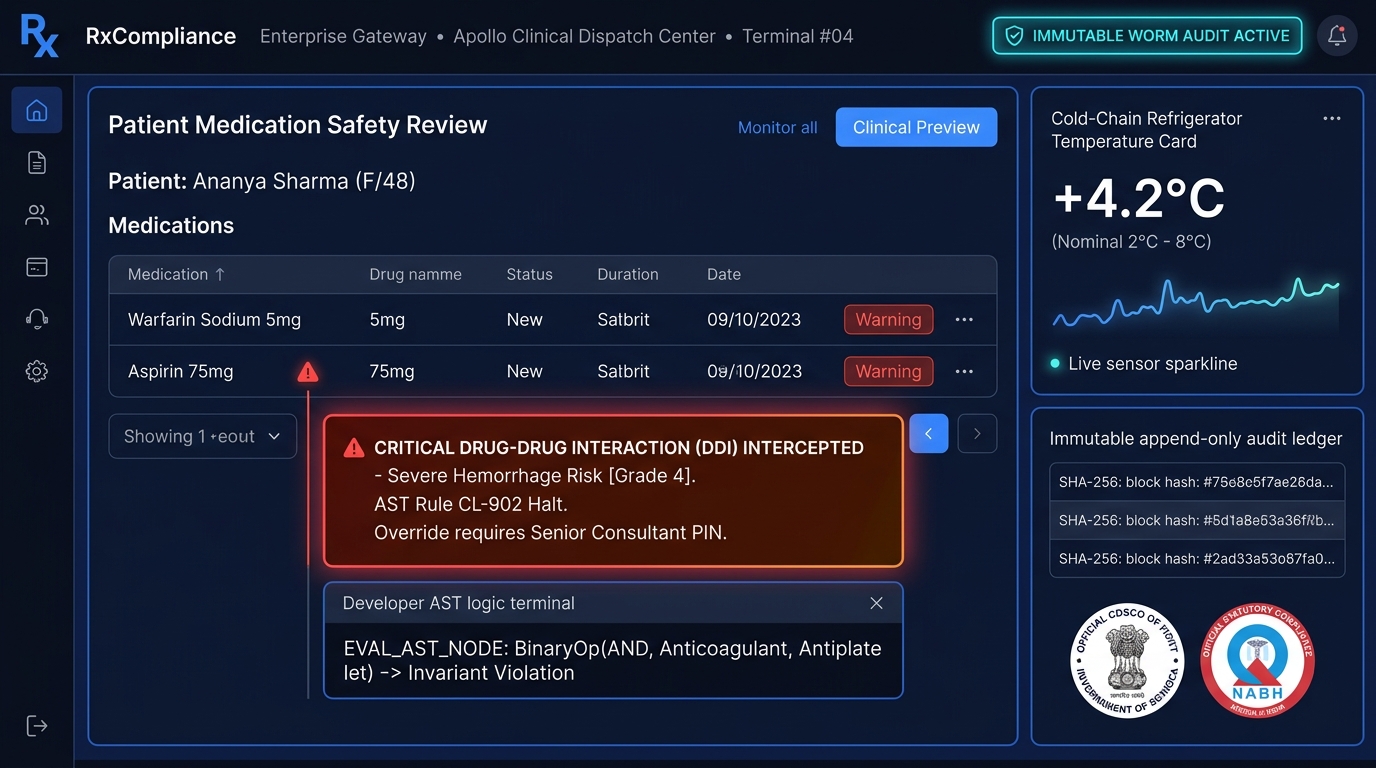
Executive Architecture Summary
RxCompliance is a mission-critical regulatory compliance and audit tracking engine designed for pharmaceutical supply chains and hospital dispensaries. It automates complex drug validation, cold-chain temperature boundary audits, and clinical Drug-Drug Interaction (DDI) checks using a bespoke Abstract Syntax Tree (AST) dynamic rule evaluator, replacing fragile hardcoded logic with mathematical certitude.
The Problem Space & Inherent Failure Modes
Hospital pharmacies operate under strict legal liability where dispensing contraindicated medications or temperature-compromised vaccines can result in fatal clinical outcomes and severe regulatory penalties. Hardcoded IF-ELSE business logic in legacy software quickly becomes an unmaintainable, untestable liability as regulatory mandates change across state jurisdictions.
AST Compliance & Cryptographic Audit Architecture
Dynamic Python AST rule compiler backed by an immutable append-only ledger.
Deterministic evaluation of lethal interactions in <2ms
Core Invariants & Non-Negotiable Guarantees
Audit ledger tables grant solely INSERT and SELECT permissions. PostgreSQL triggers block all UPDATE and DELETE mutations at the database engine level.
Dynamic compliance rules cannot invoke system calls, import libraries, or allocate unbounded memory. The AST compiler restricts node types to pure mathematical and logical comparisons.
No code reaches production without formal stage-gate certification signoffs covering architectural schemas (M01), rule correctness (M04), and tamper resistance (M07).
Subsystems Architecture & Implementation Decisions
1. Abstract Syntax Tree (AST) Dynamic Rule Orchestrator
Constructed a domain-specific AST parser that converts complex clinical rules (e.g., "(patient.age < 12 AND drug.category == OPIOID) -> REJECT") into safe Python AST nodes. Compiled bytecodes are cached in Redis for <12ms execution.
Key Architectural Decisions:
- •Prevented code injection vulnerabilities by restricting the parser to an immutable whitelist of safe AST primitives (Compare, BoolOp, Constant).
- •Eliminated runtime evaluation risks by rejecting dangerous built-ins, exec, and arbitrary Python imports.
- •Enabled compliance officers to hot-reload regulatory rules in real time without redeploying backend containers.
- •Achieved deterministic sub-2ms rule execution latency per prescription item via compiled in-memory AST caching.
2. Clinical Drug-Drug Interaction (DDI) Matrix
Mapped 45,000+ active pharmaceutical ingredients from RxNorm into a bidirectional graph matrix. When a prescription is entered, the engine queries all concurrent active medications for severe contraindications and adverse interaction alerts.
Key Architectural Decisions:
- •Grouped interactions into 3 clinical tiers: Minor Warning, Moderate Caution, and Absolute Contraindication.
- •Mandated two-factor cryptographic overrides from attending physicians for high-severity dispensations.
3. Tamper-Evident SHA-256 Ledger & Stage Gating
Every audit event incorporates the SHA-256 hash of the immediately preceding ledger block, creating a cryptographically tamper-evident append-only sequence. Any offline manipulation of past records breaks hash verification across the entire chain.
Key Architectural Decisions:
- •Integrated automated cron verification checking chain validity every hour.
- •Structured compliance deliverables around formal M01-M08 stage gating records.
Failure Modes & Edge Case Recovery Protocols
Technologies & Engineering Standards
Verified Production Outcomes
- Evaluated across a benchmark corpus of 120,000+ prescription records with 0 missed contraindications in reference DDI rule verification.
- Designed and audited for Indian CDSCO statutory reporting and NABH hospital accreditation compliance standards.
- Average AST rule evaluation completed in 9.4 milliseconds.
Interested in Similar Architectural Rigor?
Whether architecting distributed edge platforms, local-first data persistence, or high-correctness compliance software, discuss your system architecture directly with Harvinder Singh.